
Hale County Criminal Court Cases
Criminal jurisdiction in Hale County depends on the level of the charge and where the alleged conduct occurred. Circuit Court has original jurisdiction over felony prosecutions. District Court hears most misdemeanors outside an operating municipal court, conducts felony preliminary hearings, and may accept certain noncapital felony guilty pleas. Greensboro Municipal Court separately handles misdemeanor and traffic matters within its police jurisdiction. Moundville has no municipal court, so Hale District Court hears traffic offenses filed by Moundville Police Department.
The Hale County Circuit Clerk keeps the Circuit and District Court files. Those files begin when a complaint, indictment, or other charging paper opens a case. They then gather docket entries, motions, hearing orders, pleas, trial records, judgments, sentences, and court costs. A police report or jail entry is not the same file. The Hale County arrest lookup follows custody and booking, while a court case shows what prosecutors filed and how the judge or jury resolved it.
Hale County Circuit and District Courts
Both county trial-court divisions operate from the Hale County Courthouse at 1001 Main Street in Greensboro. The location matters because a felony can begin with a District Court preliminary stage before an indictment sends the prosecution to Circuit Court. Hale County District Court also handles county misdemeanors and traffic matters that do not belong in Greensboro Municipal Court. The clerk's criminal, traffic, juvenile, and warrant divisions keep those files separated by subject and access rules.
The official Hale County courts directory identifies the local courts and their roles. Its view of the county court system is shown below.
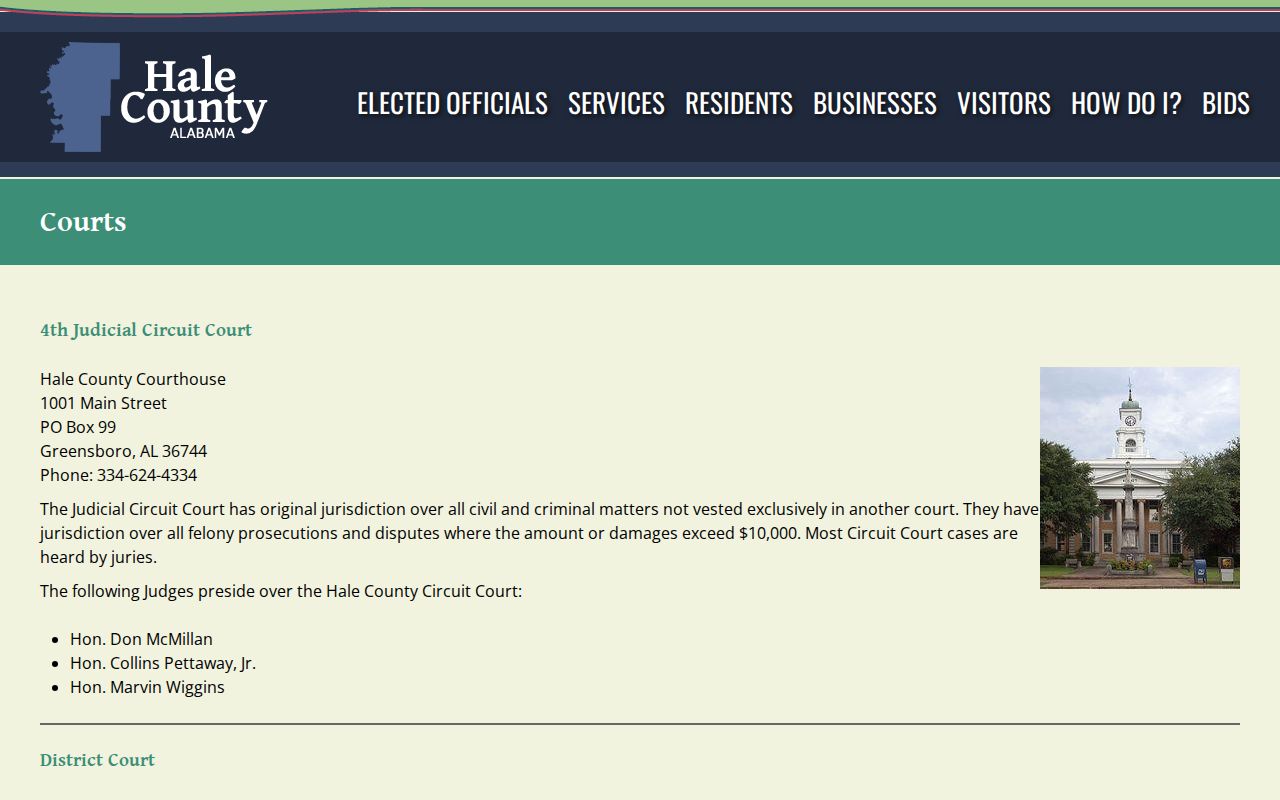
The directory helps a searcher start with the proper office instead of treating every misdemeanor, felony, and city case as one shared docket.
The Fourth Judicial Circuit also includes Bibb, Dallas, Perry, and Wilcox Counties. Some circuit judges therefore maintain offices outside Greensboro while hearing Hale County matters. The file custodian for a Hale case remains the Hale County Circuit Clerk, even when a circuit judge's main office is elsewhere.
Searching Hale County Case Records
A remote Hale County criminal case search can start with Just One Look, Alabama's paid on-demand trial-court record service. The Hale clerk points the public to that system. Registration and payment gate the current interface, so it should not be described as a free county portal. The clerk counter remains essential for document-level access, old or archived material, certified copies, and a case that does not appear in the online index.
- Open Just One Look and sign in to the paid account. Select the trial-court search that fits the known case information.
- Use the case number when available. A name search can return more than one Hale County entry, especially across years.
- Narrow the result with the filing period, court, case type, or other identifiers the current account view permits.
- Open the docket and read the filed charge, status, events, and disposition. A search-result line may not include every pleading or image.
- Contact the Circuit Clerk for inspection, a plain copy, or a certified copy. Give the case number and ask for the current charge before ordering.
| Field Label | Type | Required | Notes |
|---|---|---|---|
| Case number | Text | No | Best key for one exact court file |
| Party name | Text | No | Common starting point when the number is unknown |
| Court or location | Filter | No | Separates court divisions where the interface allows |
| Case type or year | Filter | No | Helps narrow same-name and multi-year results |
| Date of birth | Identifier | Varies | Use only when the current portal permits it |
Note: Current labels and options must be confirmed inside the paid account because the public login screen does not expose the complete search form.
Hale County Just One Look Index
Just One Look is a court-index service, not an Alabama rap sheet. It can connect a searcher to filed trial-court data such as a case number, court, filing date, status, charge, disposition, docket event, hearing, sentence, or balance. It does not establish that every arrest became a case, and account access does not guarantee that every document image is public or included in the same charge.
The official service's login and access screen appears below.
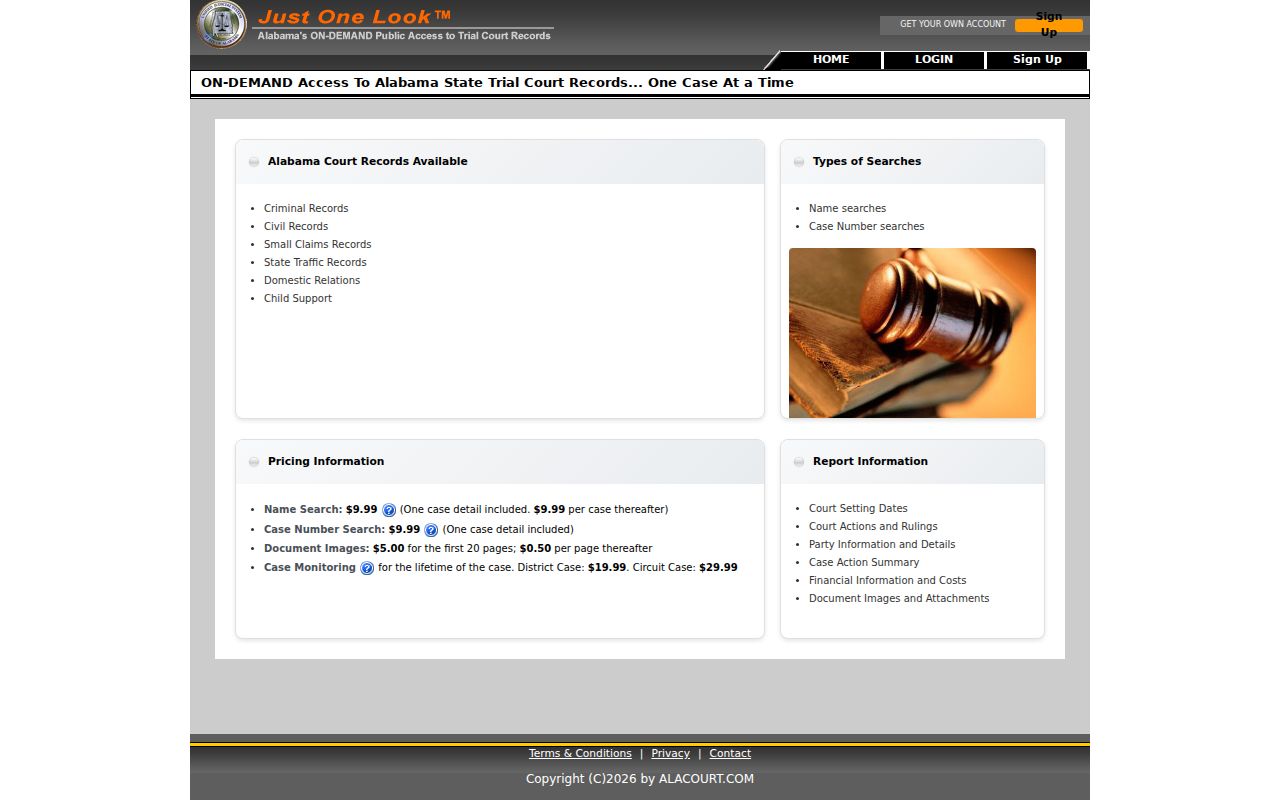
The account gate explains why the clerk counter is not merely a backup. It is the direct route for a pleading, order, judgment, or certified record that an index entry alone cannot supply.
Inside a Hale County Case File
A Hale County court file records the prosecution as filed, not just the allegation carried into jail. The docket is the running event list. Individual documents provide the detail behind those events. Someone checking an outcome should read the final disposition and judgment instead of guessing from the original charge or a scheduled hearing that may have changed.
| Case Number and Court | Identifies the particular Hale County file and trial-court division. |
|---|---|
| Charging Document | Shows the complaint, information, or indictment that states the filed allegation. |
| Docket Entries | Chronological record of filings, settings, motions, hearings, and orders. |
| Hearing Dates | Scheduled and completed appearances, subject to later resets or orders. |
| Disposition and Judgment | Records dismissal, plea, verdict, acquittal, conviction, or another final result. |
| Sentence and Conditions | Lists the court-ordered term, fine, costs, restitution, or supervision when applicable. |
Other fields can include the filed statute and class, counsel, judge, bond, financial balance, and document images. Social Security numbers, account data, protected victim or minor information, juvenile material, and Youthful Offender records do not belong in the public display.
Hale County Court Disposition Terms
Similar-looking docket terms can describe very different results. A dismissal ends a charge without a conviction. Nolle prosequi means the prosecutor declines or ends the prosecution. A no-bill means the grand jury did not return an indictment. An acquittal is a not-guilty verdict, while a conviction is a judgment of guilt. These outcomes should be read from the Hale County disposition field or final order.
- Arraignment
- The hearing where the filed charge is addressed and a plea is entered.
- Disposition
- The court's recorded result for a charge or case.
- True bill
- A grand jury returns an indictment for prosecution.
- Certified copy
- A copy attested by the clerk for formal proof of the court record.
Note: A class label helps identify the charge category, but it cannot by itself predict the final sentence or case result.
How a Criminal Case Moves
A Hale County felony can pass through an early District Court stage before Circuit Court takes the indicted case. Misdemeanor routes are different. District Court handles most nonmunicipal misdemeanors, Greensboro Municipal Court handles qualifying city matters, and Hale District Court receives Moundville Police Department traffic cases because Moundville's municipal court was abolished.
Case flow: Charges Filed › Arraignment › Pretrial › Plea or Trial › Disposition › Sentencing
Some files stop before trial through dismissal, nolle prosequi, or a grand-jury no-bill. Others end by plea, verdict, and judgment. An appeal or post-judgment filing can add a later phase. The record should be followed to its latest docket entry and final order rather than treated as complete at the first charging event.
Hale County Filed and Booking Charges
The charge delivered to Hale County jail can differ from the charge filed in court. An arresting officer records the initial allegation. The jail records the charge received at intake. The prosecutor then decides what to file, and a grand jury may decide whether to indict a felony. Charges may be amended, combined, declined, dismissed, or resolved under a different count. That is why the court case file is the better source for a prosecution's legal path.
The Fourth Judicial Circuit District Attorney prosecutes Hale County felony, misdemeanor, and juvenile matters. The office's charging role does not make all of its work public. Grand-jury deliberations remain secret, and a pending investigative file may be restricted. Public court access begins with filed material that the court can lawfully disclose.
Case Record Access & Restrictions
Alabama law supports access to public writings and trial-court records, but it does not open every court document. Ala. Code § 36-12-40 provides a citizen inspection and copy right subject to exceptions and reasonable rules. Alabama Rule of Judicial Administration 32.1 governs public electronic trial-court access while excluding confidential records.
An online view can be narrower than the releasable clerk file. Missing search results can reflect access limits, indexing, archive status, or an incorrect search key. They do not prove that no Hale County case exists. Ask the clerk to search by case number or an approximate filing range and explain whether a requested document may be inspected, copied, or certified.
Hale County Clerk Document Requests
The Circuit Clerk's criminal desk is in Suite 13 at 1001 Main Street, Greensboro, Alabama 36744. The county lists 334-624-4334, while the court microsite lists 334-624-4257 for courthouse contact. Office hours are 8:00 a.m. to 4:30 p.m., Monday through Friday. A requester should label which number supplied an answer instead of assuming one listing is wrong.
The Hale County District Judge page documents the lower court's criminal jurisdiction and local workload.
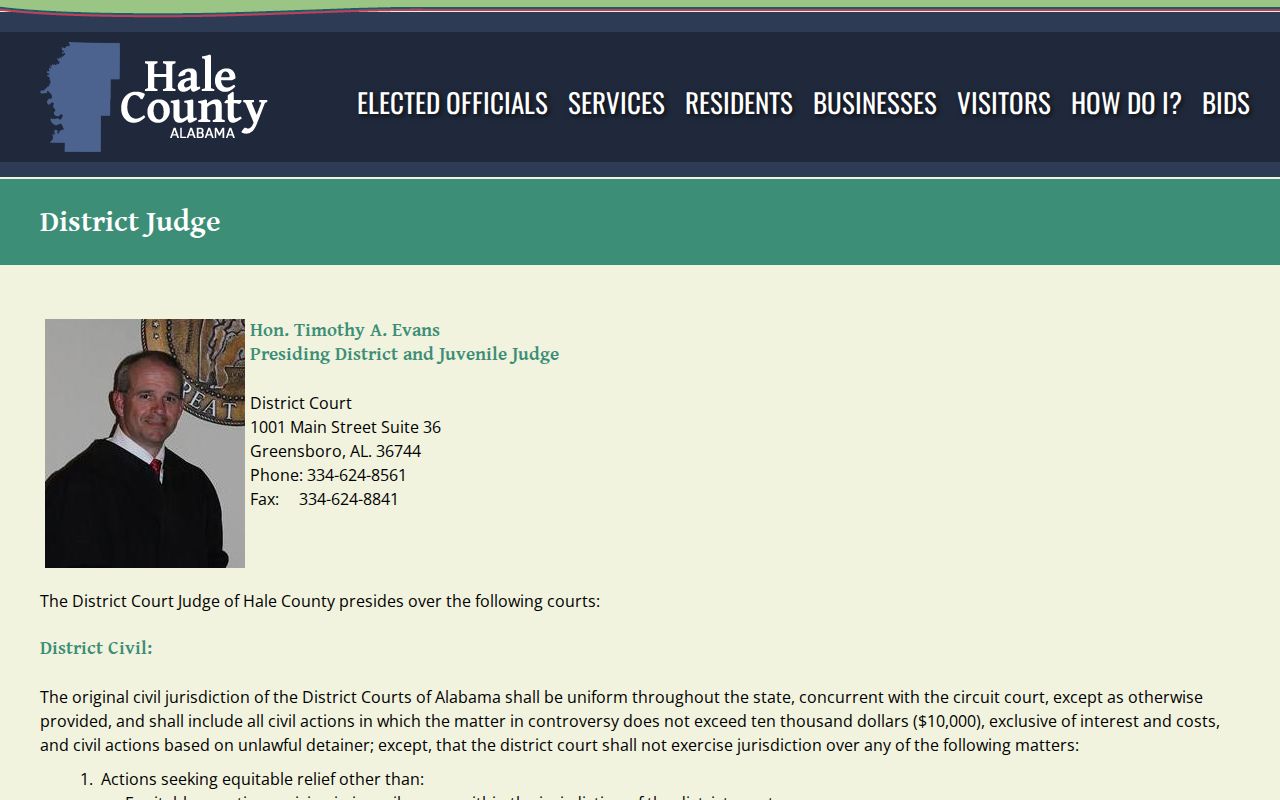
That jurisdiction detail helps route county misdemeanors, felony preliminary hearings, and Moundville traffic matters to the right Hale County court file.
For a copy request, provide the case number if known, the full name, an approximate filing period, and the exact document sought. Ask whether the item is available for inspection, as a plain copy, or as a certified copy. Hale County does not post a local copy-fee schedule, so obtain the current price before ordering or mailing payment.
Hale County Juvenile Case Limits
Juvenile proceedings and records are confidential in Hale County. Youthful Offender material is also restricted. A public trial-court search should not be used to bypass those limits, and the absence of such a file from Just One Look is expected rather than evidence of an indexing failure. Protected victim, minor, medical, and financial identifiers can also be removed from otherwise public documents.
Alabama expungement can further change access to an eligible arrest and court record after a court order. The Circuit Clerk can confirm the public status of its file, but the clerk cannot give legal advice or disclose material barred by law. A person reviewing their own record should compare the court's final disposition with an ALEA fingerprint-based self-review and use ALEA's challenge process if the repository outcome is stale or missing.